
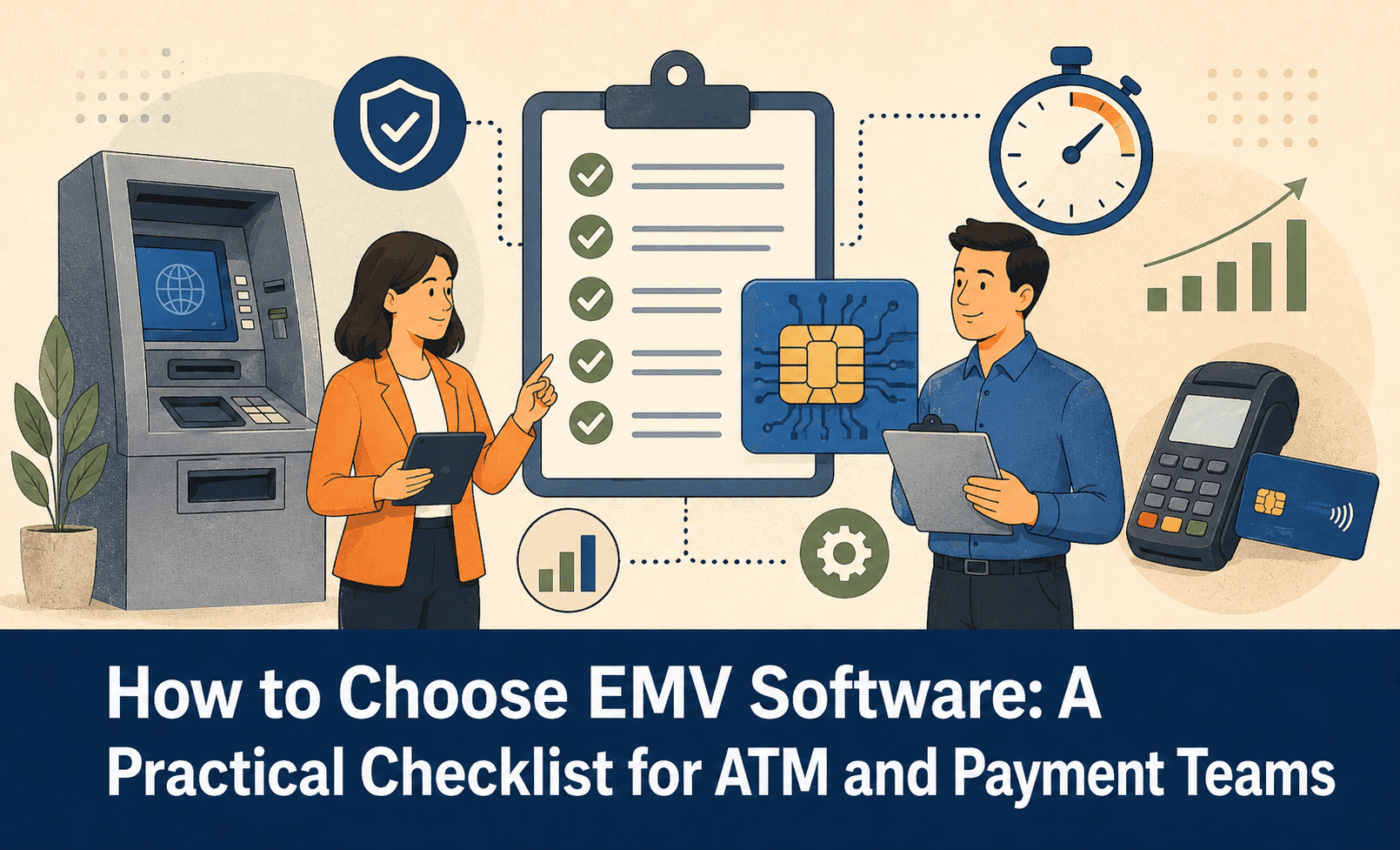
Picking the wrong EMV software is expensive. It shows up later as failed test cases, blown certification deadlines, and vendor lock-in you cannot easily escape. Picking the right one does the opposite: it shortens time to market and keeps your machines compliant for years. So before you sign anything, here is a clear checklist to evaluate any EMV software against, built around what actually matters in production.
1. Is the EMV Kernel Properly Certified?
Start at the core. The EMV kernel is the component that processes the transaction, runs the cryptography, and enforces scheme rules. Confirm it is EMV L2 certified and that the vendor appears on the official EMVCo approved-products list. Anything less means you inherit the certification burden yourself. SBS, for example, provides an EMV L2 certified kernel and is listed by EMVCo, so the heaviest validation layer is already handled.
2. Does It Support Contact and Contactless?
Self-service has moved well beyond chip-and-insert. Good EMV smartcard reader software should cover both contact transactions and contactless NFC payments, ideally in both transparent and intelligent modes. Buying two disconnected products to do this creates integration debt. SBS ships two specialized solutions, one for contact and one for contactless, each containing a certified kernel.
3. Is It Truly Multivendor?
Hardware changes. If your EMV software only works with one manufacturer's card reader, you are locked in. Insist on a multivendor solution that runs independently of the L1-certified hardware underneath. This protects your roadmap and your negotiating position.
4. Who Handles Recertification?
This is the question buyers forget to ask. EMVCo updates its standards, and every relevant change can trigger re-testing. Ask directly: when the standard changes, who does the work? A strong partner manages recertification proactively, plus ongoing maintenance, bug fixes, and scheme-driven updates, so compliance never stalls your operations.
5. Do You Get Support Through L3?
Certification spans three levels. L1 is the hardware reader, L2 is the kernel, and L3 validates your complete end-to-end solution with the card schemes. The vendors worth shortlisting do not just hand you software. They guide your team through L3 quality assurance and testing, reducing the internal effort needed for final sign-off.
Frequently Asked Questions
Is "EMV reader writer software" the same as an EMV kernel? No. A certified EMV kernel is payment-processing software that reads and authenticates chip cards inside terminals and ATMs. It is not card-writing or personalization software.
What is the single most important factor? Certification status. A pre-certified, multivendor L2 kernel removes the largest source of delay and risk from any EMV project.
Can a vendor reduce our certification timeline? Yes. Starting from a certified kernel and getting hands-on L3 support is the most reliable way to compress the schedule.
The Bottom Line
The best EMV software is not just code, it is certification plus a long-term partner. SBS pairs certified contact and contactless kernels with consulting across the full ATM lifecycle. To scope your project, reach the team at info@sbs.co.at.
Sources
EMVCo, Approved Products listing: https://www.emvco.com/approved-products/
EMVCo, "How do EMV Chip Specifications Tackle Card Fraud?": https://www.emvco.com/knowledge-hub/how-do-emv-chip-specifications-tackle-card-fraud/
SBS Software, EMV Kernel product page (contact and contactless solutions, EMV L2 certification, multivendor and PCI compliance, L1/L2/L3 support, recertification and maintenance): https://www.sbsinnovate.com/bankensoftware/kixclc-chipmodul