
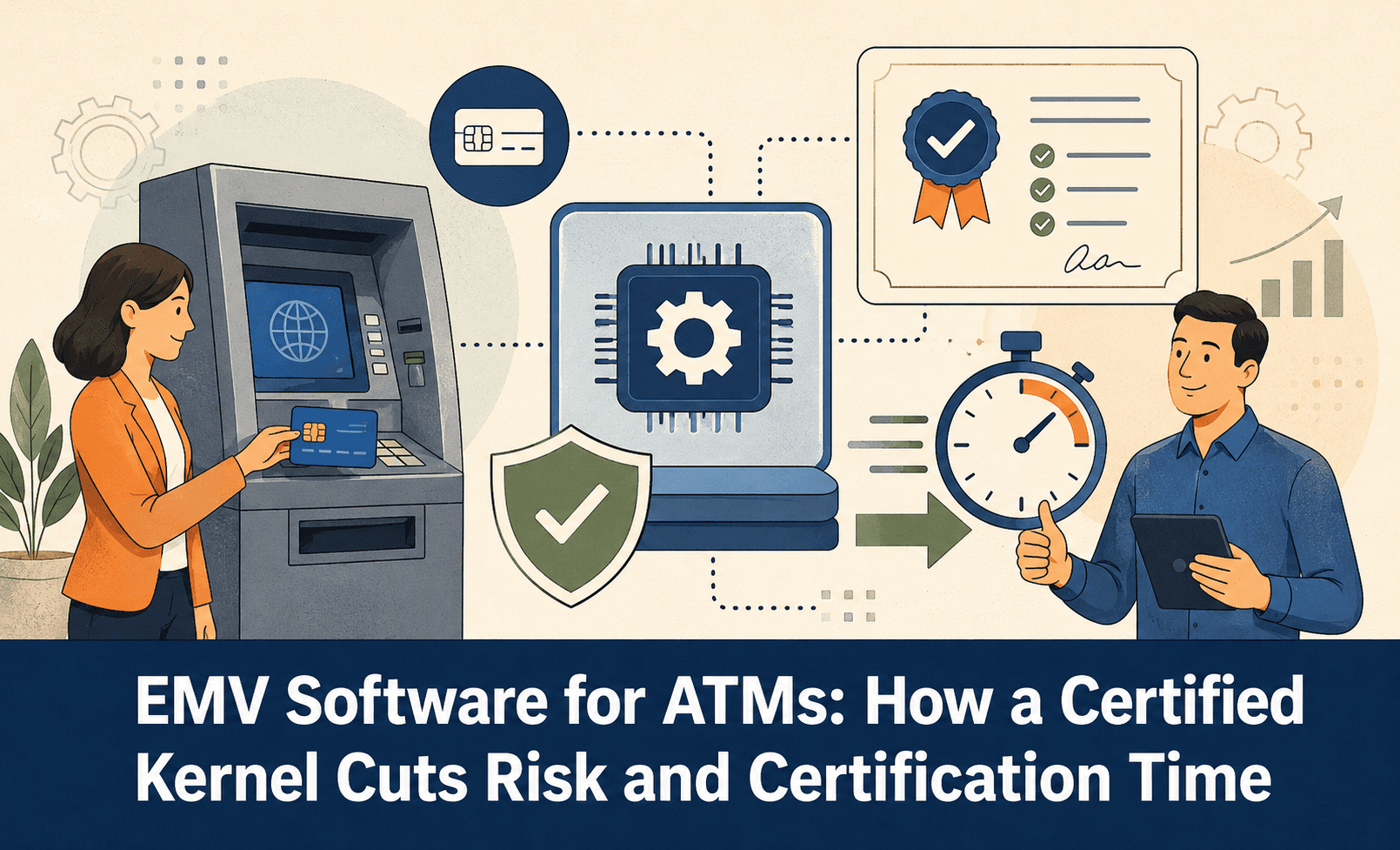
Every chip transaction at an ATM depends on something customers never see: the EMV software running quietly behind the card reader. Get that layer right and payments are fast, secure, and audit-ready. Get it wrong and you face failed certifications, stalled rollouts, and avoidable fraud exposure. The stakes are real. According to EMVCo, counterfeit card fraud has dropped sharply in markets that adopted chip technology, falling around 90% in the UK and 76% in Canada, with nearly 10 billion EMV chip cards now in circulation worldwide.
What EMV Software Actually Does
EMV software is the logic that lets a terminal read a payment chip, authenticate it, and process the transaction under the rules set by Visa, Mastercard, American Express, and other networks. At its core sits the EMV kernel: the certified component that handles transaction flow, runs the required cryptography, and enforces scheme compliance. Strong EMV smartcard reader software does this reliably across hardware from different manufacturers, so you are never locked into a single vendor.
Contact and Contactless, Both Covered
Modern self-service needs both worlds. SBS provides two specialized, EMV L2 certified solutions: one for contact-based smartcard transactions and one for contactless NFC payments. The contactless module supports both transparent and intelligent modes, giving integrators flexibility without sacrificing security. Both are PCI-compliant and built for multivendor environments, which means cleaner integration into your existing ATM software stack.
Why Certification Is the Real Challenge
EMV certification is not a one-time checkbox. It spans three layers:
L1 covers the physical card reader and is certified by the hardware manufacturer.
L2 is the EMV kernel, the transaction-processing brain that must pass hundreds of test cases.
L3 validates your complete end-to-end solution with the card schemes.
Every relevant change to hardware or software can trigger re-testing, tying up skilled engineers and slowing your roadmap. A certified kernel paired with expert support removes most of that weight.
Beyond Software: A Long-Term Partner
Choosing EMV software is also choosing a partner. SBS embeds the kernel into your environment, guides your team through L3 quality assurance, and proactively manages recertification whenever EMVCo updates the standard. Maintenance, bug fixes, and scheme-driven changes are handled for you, so your machines stay compliant without operational disruption.
Frequently Asked Questions
Is an EMV kernel the same as "EMV reader writer software"? No. That phrase is often searched loosely, but a certified EMV kernel is transaction-processing software for payment terminals and ATMs. It reads and authenticates chip cards to complete legitimate payments. It does not write or personalize cards.
How long does EMV certification take? Timelines vary by scope, but the heaviest lift is the L2 test suite and L3 end-to-end validation. Starting from a pre-certified kernel shortens that path considerably.
Can one solution support multiple card brands and hardware vendors? Yes. A multivendor, L2 certified kernel supports the major global networks and works independently of the card reader manufacturer.
Ready to Simplify EMV?
If certification cycles are slowing you down, the right EMV software turns compliance into a competitive edge. SBS combines a certified contact and contactless kernel with hands-on consulting across the full ATM lifecycle. Talk to the team at info@sbs.co.at to scope your project.
Sources
EMVCo, "How do EMV Chip Specifications Tackle Card Fraud?" (counterfeit fraud reduction figures and global EMV card volume): https://www.emvco.com/knowledge-hub/how-do-emv-chip-specifications-tackle-card-fraud/
EMVCo, Approved Products listing: https://www.emvco.com/approved-products/
SBS Software, EMV Kernel product page (contact and contactless solutions, EMV L2 certification, multivendor and PCI compliance, L1/L2/L3 support, recertification and maintenance): https://www.sbsinnovate.com/bankensoftware/kixclc-chipmodul