
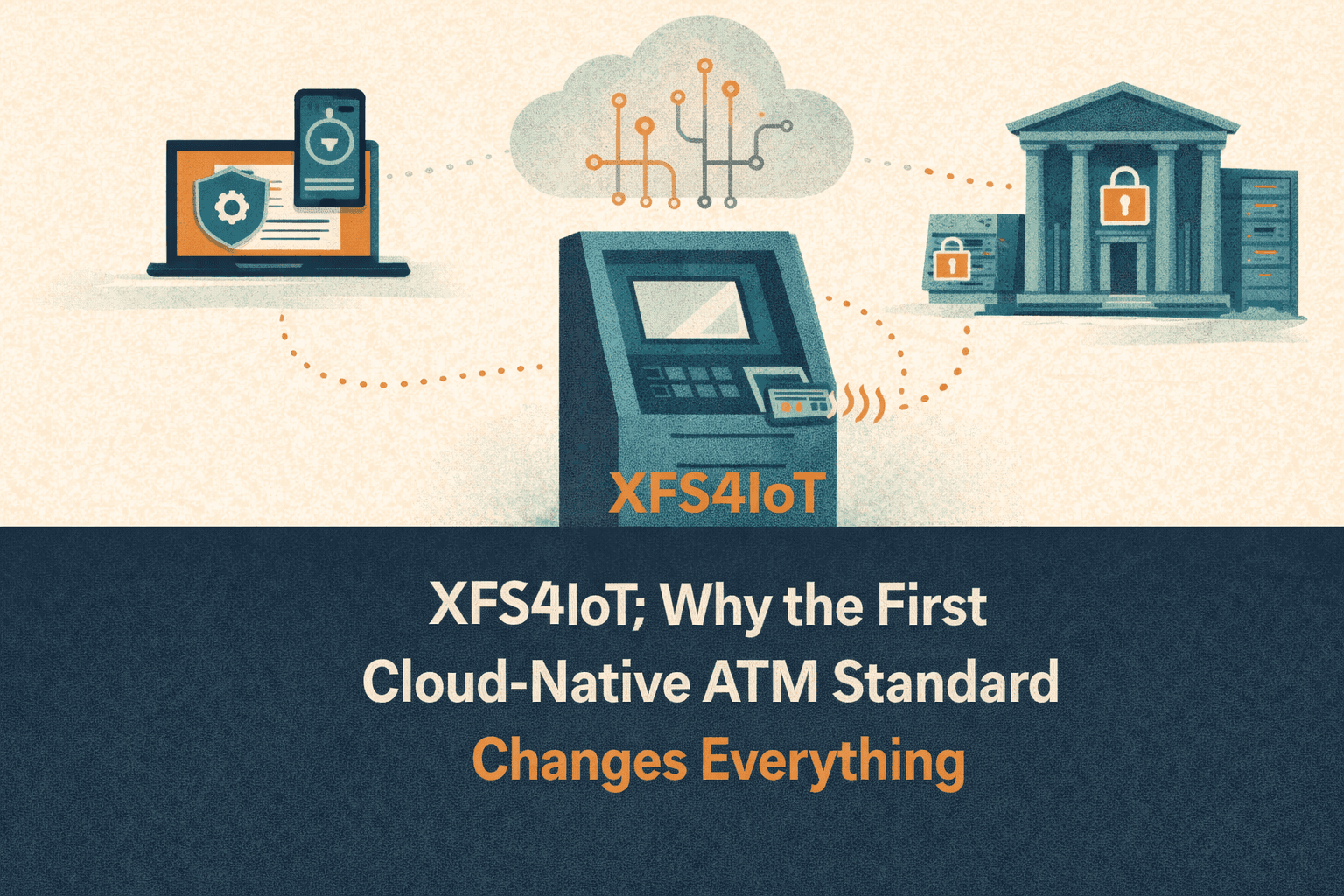
For more than two decades, ATM innovation has been constrained by a single reality: tight coupling between hardware, operating systems, and proprietary software stacks. According to the ATM & Self-Service Software Trends 2025/26 report, that reality is now starting to change and the catalyst is XFS4IoT.
What Is XFS4IoT and Why It Matters Now
XFS4IoT is the latest evolution of the long-running CEN/XFS standard that powers roughly 90% of the world’s ATMs. Published in March 2024 by the European Committee for Standardization (CEN), XFS4IoT introduces a cloud-native, API-driven, operating-system-agnostic architecture.
In practical terms, this removes the historic Windows-only dependency and enables banks to:
Run ATM software on different operating systems
Integrate multi-vendor hardware more easily
Address and manage devices locally or from cloud applications
At a time when Windows 10 support sunsets and Windows 11 migrations strain budgets and resources, this flexibility is no longer theoretical, it is operationally relevant.
A Knowledge Gap with Strategic Consequences
Despite its potential, the report highlights a striking reality: only 14% of banks say they understand XFS4IoT in some detail, while more than half report low or no familiarity at all.
Yet when respondents were shown XFS4IoT’s capabilities, interest was immediate:
30% ranked OS independence as the most attractive benefit
28% cited cloud-based ATM services
28% pointed to flexible hardware integration
This gap between low awareness and high relevance suggests that many institutions may be making long-term infrastructure decisions today without fully understanding the alternatives available to them.
Lower Costs, Faster Change, Stronger Security
The report positions XFS4IoT as a direct response to three of the biggest barriers to ATM innovation identified by banks:
High costs
Legacy technologies
Integration difficulties
By enabling remote updates, centralized diagnostics, and cloud-based control, XFS4IoT reduces the need for physical service interventions, which is a key driver of total cost of ownership. At the same time, the specification defines end-to-end security with mutual authentication, addressing the growing attack surface created by contactless and connected services.
The Bigger Picture: From ATMs to Platforms
XFS4IoT is not just a technical upgrade. It is a structural shift that turns ATMs into extensible platforms rather than fixed-function machines. In a landscape where banks are closing branches, outsourcing operations, and aligning physical channels with digital ones, this shift is foundational.
The report makes one thing clear: ATMs are not going away. But the banks that extract long-term value from them will be those that break free from legacy constraints and XFS4IoT is emerging as a key enabler of that transition.
Sources:
ATM & Self-Service Software Trends 2025/26, ATM Marketplace & KAL ATM Software, 2025.