
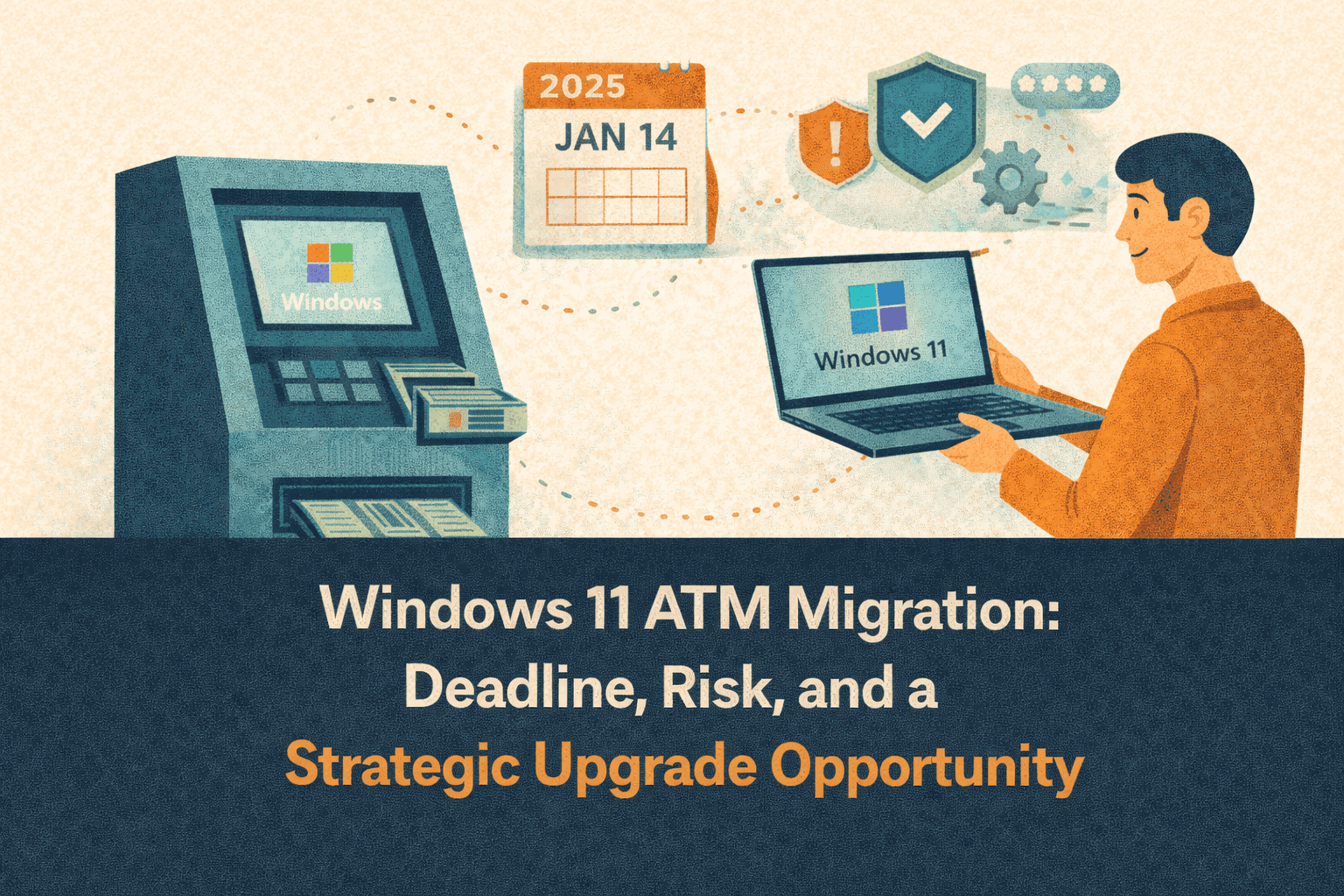
The clock is ticking for ATM operators worldwide. Microsoft will end mainstream support for Windows 10 on October 14, 2025, creating a hard deadline for financial institutions running ATMs on legacy builds. According to the ATM & Self-Service Software Trends 2025/26 report, this transition is already underway, but many networks are still exposed.
The migration to Windows 11 for ATMs is not just a routine operating system update. It is a security, compliance, and infrastructure challenge that demands strategic planning.
Where Banks Stand Today
The report shows that:
23% of banks have already upgraded some or all of their ATMs to Windows 11
37% plan to begin migration soon
18% have taken no action yet
This means a significant portion of ATM fleets still rely on operating systems approaching end-of-support status.
Once Windows 10 support sunsets, unsupported ATMs will no longer receive critical security patches, which is increasing exposure to fraud, cyber threats, and compliance risks, particularly around PCI standards.
The Hardware Compatibility Challenge
Migrating ATMs to Windows 11 is not as simple as installing a new OS. Many older ATM cores are incompatible.
The report highlights:
Intel Gen 4 processors cannot support Windows 11 and must be replaced.
Intel Gen 6 or 7 cores may continue running Windows 10 through 2032, but require BIOS and TPM upgrades.
Intel Gen 10 or newer processors are fully compatible with Windows 11.
For large ATM fleets, this creates a mix of replacement, upgrade, and “safe” categories. This requires detailed fleet inventory and classification before any rollout begins.
The Logistics Bottleneck
Even for prepared institutions, migration is operationally complex. A full fleet-wide ATM upgrade typically takes 9 to 12 months.
Compounding the challenge:
Chip shortages and hardware delays
Limited technician availability
As deadlines approach, competition for technical resources will intensify. Late movers risk supply constraints and rushed deployments.
Turning Migration into Modernization
While the Windows 11 ATM upgrade cycle presents clear challenges, it also creates an opportunity:
Inventory and assess your fleet to determine which machines require replacement vs. upgrades.
Prioritize high-risk machines running unsupported builds.
Plan phased rollouts to avoid last-minute disruption.
Future-proof investments by selecting modern cores that can support upcoming OS versions.
Forward-thinking institutions are using this migration window to evaluate broader ATM strategy, including software modernization, remote management capabilities, and integration readiness.
Security and Stability Through 2034
One advantage of Windows 11 IoT Enterprise LTSC 2024 is its long-term support horizon through 2034, offering a more stable platform for future planning.
In an industry where high costs (cited by 46% of banks as the main barrier to innovation) and legacy technologies remain persistent challenges, aligning OS migration with broader infrastructure renewal can reduce repeated upgrade cycles.
The Bottom Line
The Windows 11 ATM migration deadline is unavoidable. The real question is whether it becomes a reactive compliance exercise or a catalyst for strategic modernization.
Institutions that act early, classify their fleets carefully, and align operating system upgrades with long-term ATM strategy will minimize risk while positioning their networks for greater resilience and efficiency.
Waiting is no longer a neutral option.
Source
ATM & Self-Service Software Trends 2025/26, ATM Marketplace & KAL ATM Software, 2025.