Windows 10 End-of-Life: The ATM Migration Pressure No Bank Can Afford to Ignore

Niklas Damhofer
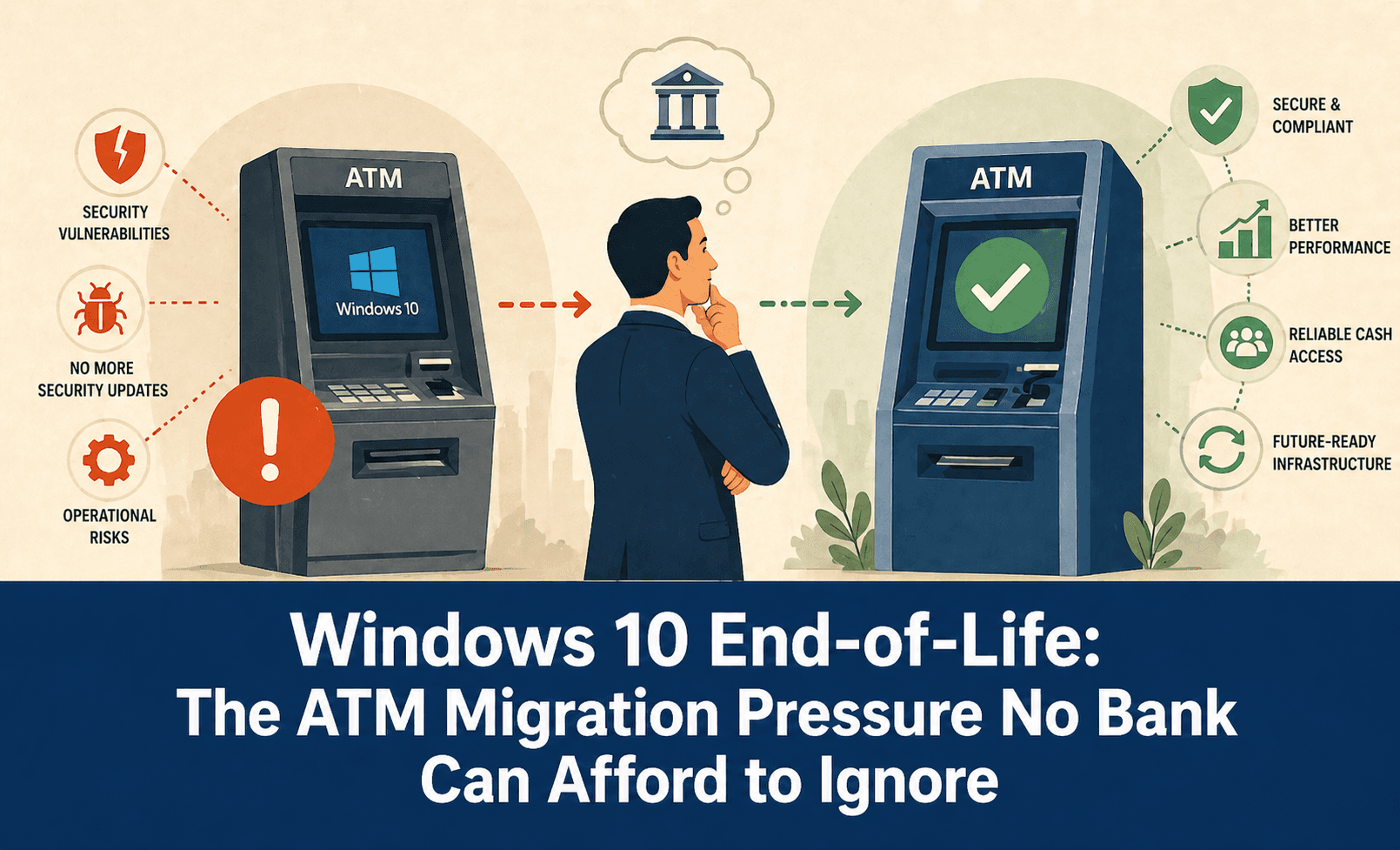
The clock has already run out. On October 14, 2025, Microsoft officially ended support for Windows 10, and yet thousands of ATMs across Europe and beyond are still running on it. For banks, this isn't a routine IT update. It's a regulatory, security, and reputational landmine ticking in plain sight. Here's what's really at stake, and how forward-looking institutions are migrating without a single customer-facing disruption.
What Windows 10 End-of-Life Actually Means for ATMs
Microsoft's deadline is unambiguous. As of October 14, 2025, the standard editions of Windows 10 (version 22H2) no longer receive security patches, bug fixes, or technical support. The machines keep running, but every newly discovered vulnerability stays open forever.
For ATMs, the picture has one important nuance, many devices run Windows 10 LTSB 2016 (Long-Term Servicing Branch), a specialized version Microsoft designed for embedded systems like medical equipment and ATMs. According to Hyosung Americas, this version is "old enough that an updated PC core will likely be required to support Windows 11," and Microsoft will end support for it in October 2026. That's not a long runway. It's the final boarding call.
Why Running an Unpatched ATM Is a Bigger Problem Than It Sounds
Banks underestimate this risk at their peril. Three forces converge the moment an OS goes end-of-life:
Cybersecurity exposure. Cybercriminals actively target end-of-life operating systems because exploits remain usable indefinitely without vendor fixes. ATM jackpotting and black box attacks already cost the industry millions; running an unpatched OS is an open invitation.
PCI DSS compliance failure. PCI DSS requires patched, monitored, and protected payment systems. Running a knowingly unpatched OS interacting with cardholders puts banks in breach and at risk of losing cyber insurance coverage.
Regulatory and reputational fallout. Under SEC cyber disclosure rules, breaches must be reported faster and more transparently than ever. A jackpotting incident traced to an unpatched ATM is a headline no bank wants.
The Migration Window Is Narrower Than You Think
Two facts reframe the entire planning calendar.
First, Windows 11 IoT Enterprise LTSC 2024 is supported through October 2034, giving banks roughly a decade of stability if they migrate now. Second, the major ATM manufacturers are already moving. Diebold Nixdorf has completed the first-ever Windows 11 ATM deployment, rolling its IoT Enterprise LTSC 2024 build out to two banks in Central Asia, while Hyosung Americas has finalized its supporting software.
The catch? Many existing ATMs cannot simply be upgraded. Older PC cores often need to be replaced before Windows 11 will run, and upgrade kits for compatible models are estimated at $5,000–$8,000 per machine with limited availability. Multiply that across a fleet of hundreds or thousands of terminals and the cost of waiting becomes brutally clear.
How to Migrate an Entire ATM Fleet Without Downtime
This is where having the right software partner separates a smooth transition from a disaster. SBSInnovate has been delivering ATM software since 1988 and powers more than half of all ATMs in the DACH region. When German banks needed to migrate their self-service devices to Windows 10, the SBS team executed the project with a clear customer verdict: "the Windows 10 migration of the self-service devices was a critical project that was implemented without any problems and rolled out without any disruptions for the banks and their customers."
The same playbook now applies to Windows 11. SBS' multivendor architecture, KIXXtensions, runs identically across Diebold Nixdorf, NCR, GRG Banking, Glory, Keba, and Hess hardware via the CEN/XFS standard. KIXOperator Distributor pushes complete software packages, including OS patches and firmware, to thousands of ATMs remotely, eliminating manual update work and accelerating patch cycles. In a previous large-scale rollout for a large ATM Operator, SBS migrated up to 1,000 ATMs per night using an unattended deployment process, with terminals back online for customers the next morning.
That's the operational answer to a regulatory deadline.
The Bottom Line
Windows 10 end-of-life isn't a future risk. It's a present one. Standard Windows 10 support ended in October 2025, the LTSB 2016 deadline lands in October 2026, and every month in between adds compliance exposure, security risk, and budget pressure. Banks that start migration planning now will move to Windows 11 IoT LTSC 2024 with a decade of runway ahead. Those that wait will pay more, in capital, in compliance fines, and potentially in headlines. The only real question is who you trust to execute it.
Sources
Microsoft Support — Windows 10 support has ended on October 14, 2025
Microsoft Learn — Lifecycle FAQ for Windows
Digital Transactions — Diebold Nixdorf's Windows 11 ATMs Signal the Next Era
Serverman — Windows 10 End of Life: What It Means for You
CSO Online — One year until Windows 10 ends: Here's the security impact of not upgrading
LD Systems — Windows 10 Deadline: Is Your ATM Ready?