Why India Is Becoming the World's Most Exciting ATM Market (And What Banks Must Do Next)

Niklas Damhofer
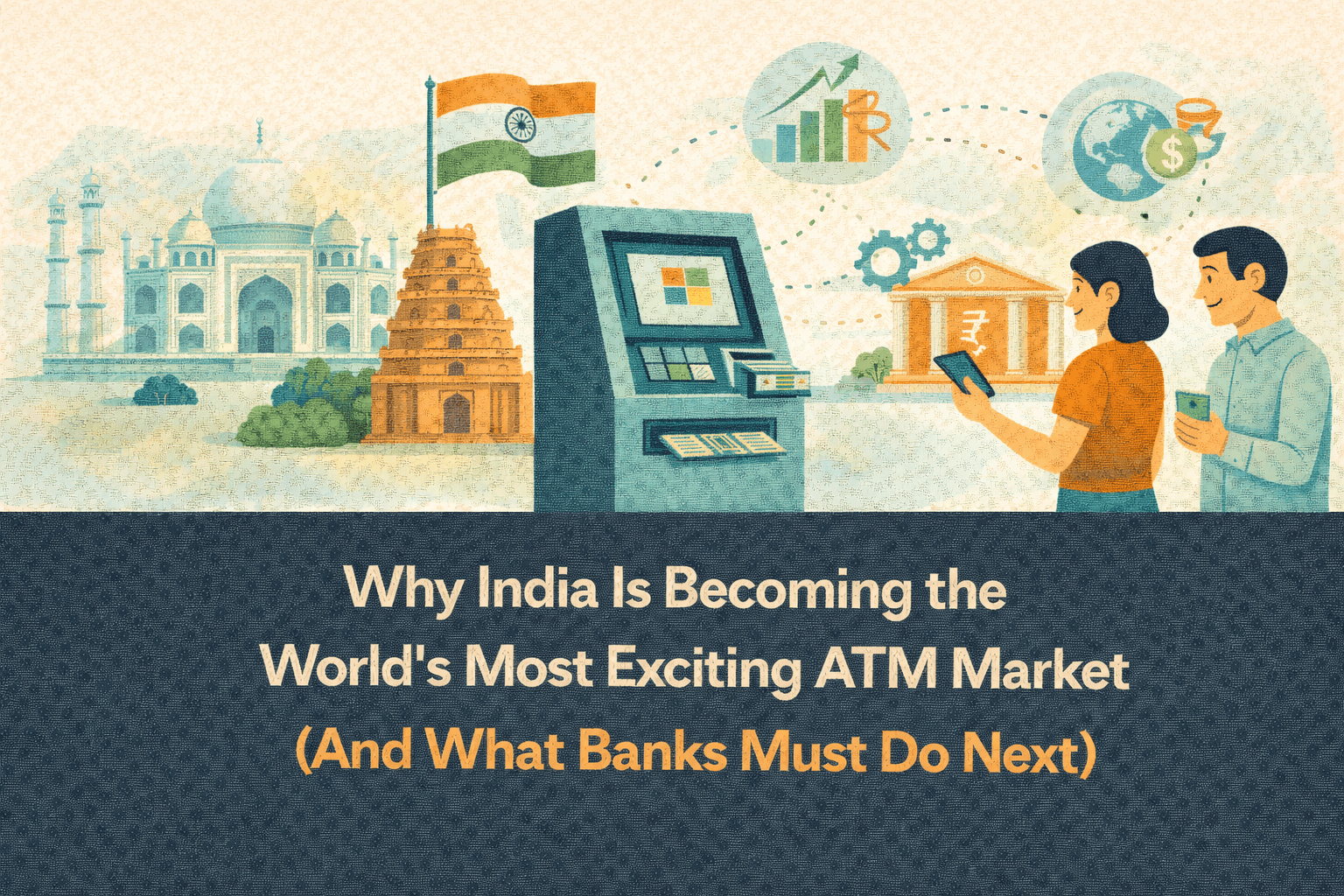
India is at a crossroads. Its banking sector is expanding faster than almost anywhere else on the planet, yet millions of citizens still live outside the formal financial system. The question keeping banking executives up at night is not whether to grow. It is how to grow smartly, reaching underserved communities without repeating the costly infrastructure mistakes that Western banks spent decades trying to undo.
A Nation Vastly Underserved by Its Own Banking System
Walk through Mumbai or Delhi and you will find ATMs on almost every corner. Drive two hours into rural Maharashtra or Bihar and you may not find one at all. That imbalance is the defining challenge of Indian banking today.
Compared to other major economies, India's ATM coverage relative to its population remains significantly below the global average. Bank account penetration tells a similarly sobering story. Among the BRIC nations, India has historically ranked last in the share of adults holding a formal bank account. The gap between urban access and rural reality is not just a social issue. It is a massive, largely untapped commercial opportunity.
Expansion Alone Is Not the Answer
It would be tempting to treat this as a simple numbers problem: build more ATMs, open more accounts, job done. But banking leaders gathering at the India ATMs 2015 conference in Mumbai heard a more nuanced message, particularly from European institutions with hard-won experience.
Banks from Western markets urged their Indian counterparts to resist the urge to measure progress purely in ATM deployments. The lesson from Europe and North America was clear: when banks build infrastructure in silos, without a coherent strategy connecting physical machines to digital channels and customer data, they create legacy systems that become expensive and painful to update later.
The smarter path is an omni-channel approach. Rather than treating the ATM as the goal, forward-thinking banks treat it as one touchpoint within a broader customer journey that includes mobile, digital, and in-branch experiences. Building that kind of flexibility from the start is far easier than retrofitting it later.
Technology That Pays for Itself
One of the most practical shifts happening inside Indian banking is the move toward cash recycling. For years, the model was simple and inefficient: cash goes out through withdrawals, and staff manually process deposits at the counter. Cash recycling flips that dynamic by allowing ATMs to accept deposits and recirculate that cash directly back into the machine for withdrawals.
The financial logic is compelling. Fewer cash-in-transit runs. Lower staffing costs at the counter. Faster deposit processing. Interest earned on cash sooner. Banks that have piloted this technology, both in India and internationally, have found it cuts operating costs in ways that add up quickly across a large network.
The key insight shared at the conference was that perfect balance between deposits and withdrawals at every machine is not required for cash recycling to work. Even machines with significant variation in transaction mix can generate meaningful savings. That removes one of the most common reasons banks hesitate to invest.
Reaching Rural Customers Is a Business Strategy, Not a Charity
Perhaps the most important mindset shift in Indian banking is the realization that serving rural and low-income customers is not just a regulatory obligation. It is a genuine growth strategy.
The RBI has been clear on this point. As banks use ATMs and other technology to access harder-to-reach customers, rural business is growing in ways that were not anticipated when these efforts were framed primarily as financial inclusion mandates. The commercial case is becoming impossible to ignore.
HDFC Bank illustrated this with one of the most creative banking innovations in recent memory. Recognizing that small dairy farmers had no collateral to secure traditional loans and no transaction history with formal banks, the bank designed an ATM specifically for them. Farmers could deposit milk and instantly receive credit to their accounts. Over time, those transaction records became the foundation for small business loans that helped farmers grow their operations.
This approach did not just win HDFC new customers. It demonstrated that innovation designed for the most underserved users often produces the most original and defensible business models.
What Indian Banks Should Prioritize Right Now
The banks that will define India's next decade of financial growth share a few things in common. They are investing in software and data analytics alongside physical infrastructure. They are designing for rural customers from the start, not as an afterthought. And they are building flexible, connected systems that can evolve as customer behavior changes.
The ATM is not going away. But its role is shifting from a simple cash-dispensing machine to an intelligent touchpoint in a much larger banking ecosystem. In a country as large and diverse as India, that shift is not just a technology upgrade. It is the difference between a banking system that works for everyone and one that continues to leave millions behind.
The opportunity is enormous. The direction is clear. The banks willing to think beyond the machine will be the ones that shape what Indian banking looks like for generations to come.