
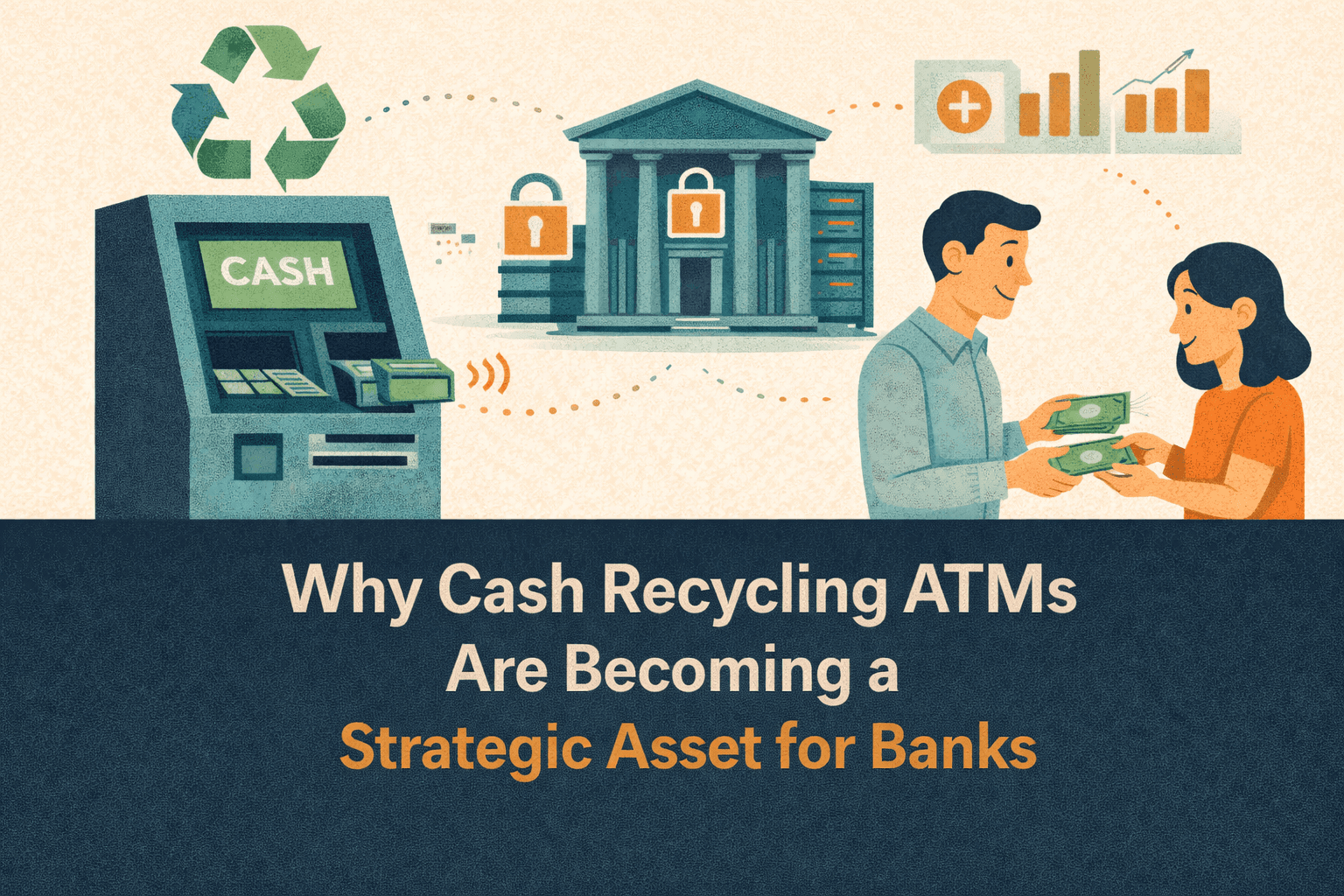
Despite years of predictions about a cashless future, the ATM & Self-Service Software Trends show a different reality. Cash usage is not disappearing, it is changing. At the center of this shift is the rapid rise of deposit-enabled ATMs with cash recycling capabilities.
Cash Deposits Are Driving ATM Relevance
According to the report, 70% of banks have seen increased customer demand for cash deposits at ATMs, making it the fastest-growing ATM transaction type. This growth is not driven by consumers alone. Small and medium-sized businesses (SMBs) play a decisive role.
Industry research cited in the report shows that 70% of cash entering branches comes from SMBs, and 75% of SMBs are willing to deposit funds via self-service devices. The key driver is convenience. Many businesses generate cash outside traditional branch hours, making 24/7 deposit-enabled ATMs far more practical than teller-based services.
As branch networks shrink globally, ATMs are increasingly filling the gap, not just as cash dispensers, but as always-on deposit channels.
Cash Recycling Reduces Cost and Complexity
Deposit-enabled ATMs become significantly more powerful when paired with cash recycling. Instead of treating deposited cash as idle inventory, recyclers allow banks to reuse deposited notes for withdrawals.
The report highlights several tangible benefits:
Lower cash-in-transit (CIT) costs
Fewer replenishment visits
Improved cash availability across denominations
One cited example shows a branch reducing CIT visits from three times per week to once every two weeks after introducing cash recycling, which helped cutting costs dramatically.
Supporting a Closed-Cash Ecosystem
Cash recycling also enables what banks increasingly describe as a closed-cash ecosystem. Deposits from local businesses circulate back into the same community through withdrawals, reducing external cash dependencies and improving forecasting accuracy.
This model is especially valuable in:
Cash-heavy economies
Regions with reduced branch coverage
High-volume retail and SME environments
The report notes that cash recyclers accounted for 59% of global ATM shipments in 2024, up from 55% the year before, a clear indicator that banks are voting with their investment budgets.
More Than Cost Savings
While cost reduction is a major driver, cash recycling is also about resilience and trust. Several interviewees in the report point out that recent digital payment outages have reinforced customer confidence in cash as a technology-independent fallback.
In this context, cash recycling ATMs are not legacy infrastructure. They are risk-mitigation tools that support continuity when digital channels fail.
The Takeaway
Cash recycling is no longer a niche feature. It is becoming a core design principle for modern ATM networks. Banks that treat deposit-enabled, recycling ATMs as strategic infrastructure rather than cost centers are positioning themselves for a future where cash and digital channels coexist, not compete.
Sources:
ATM & Self-Service Software Trends 2025/26, ATM Marketplace & KAL ATM Software, 2025.