
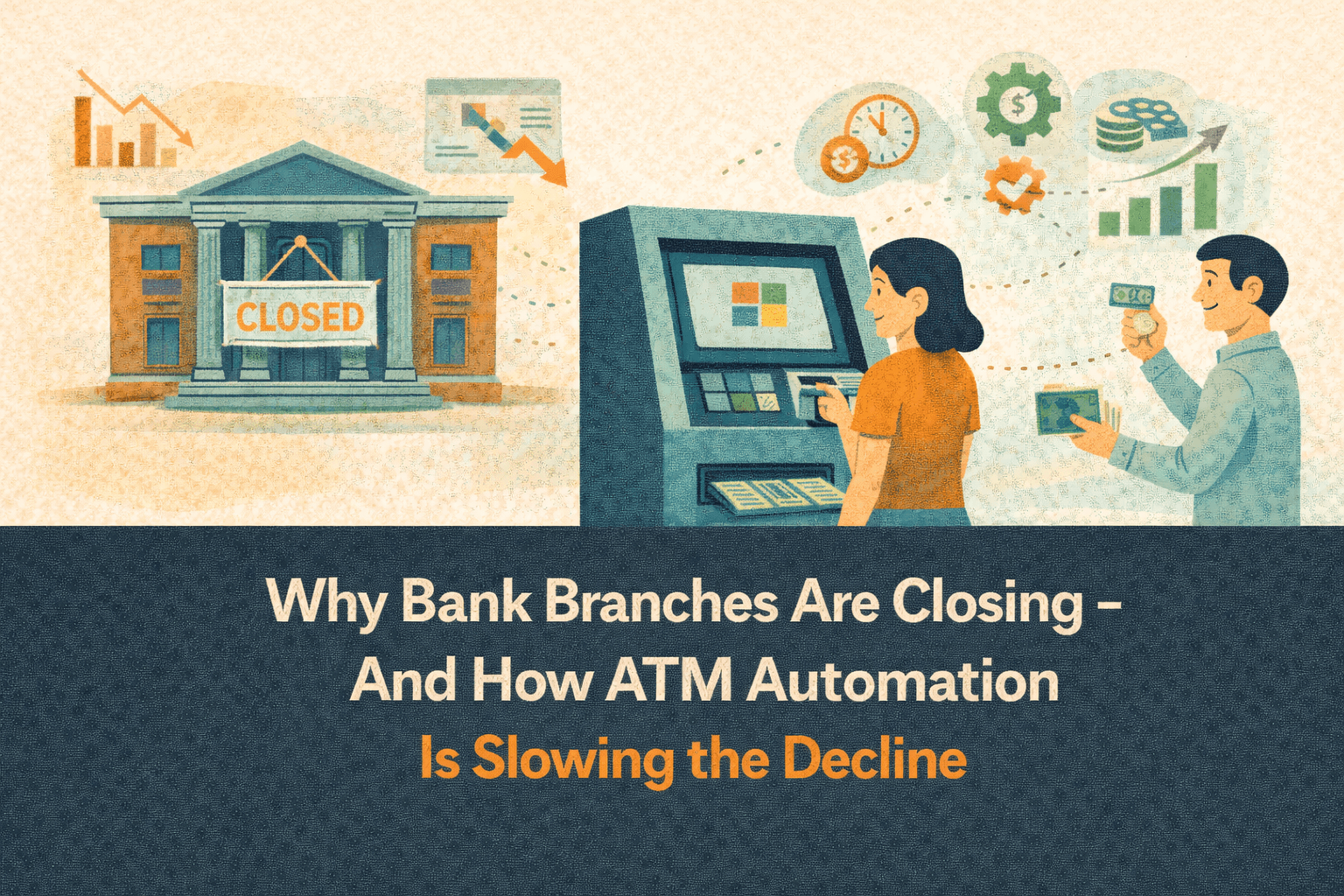
Bank branch closures are making headlines worldwide, and the data confirms the trend is accelerating. According to RBR Data Services' Global ATM Intelligence Service 2023, the number of bank branches globally is expected to keep falling through 2028 - in every region except Asia-Pacific. So what's driving this shift, and what can banks do to stay relevant?
The Main Drivers Behind Branch Closures
The primary cause is the rapid adoption of digital and mobile banking. In large markets like China, millions of customers now manage finances entirely through their smartphones. In Kenya, programmes like M-Pesa have brought financial services to underserved rural populations without a single branch visit.
Cost pressure plays an equally big role. In Latin America, banks have long relied on third-party agent networks, known as corresponsales, as a cheaper alternative to physical branches. In Brazil, fierce competition from fintechs like Nubank has forced traditional banks to cut costs sharply, and branch closures are an obvious target.
Which Countries Are Still Opening Branches?
Not every market is contracting. Mexico's state-owned Banco del Bienestar opened over 900 new branches in 2022 alone, targeting underbanked communities. Pakistan and India are also expanding their branch networks as banking infrastructure matures and rural cash demand remains strong. Financial inclusion, not just profitability, is driving growth in these markets.
How ATM Automation Is Filling the Gap
For banks reducing their physical footprint, off-site ATMs and advanced self-service technology are becoming critical. The goal is to handle routine transactions - cash withdrawals, deposits, balance enquiries, without requiring branch staff.
One of the most impactful technologies is the cash recycling ATM. Traditional ATMs require frequent cash-in-transit (CIT) visits to replenish notes. Recycling ATMs allow deposited cash to be recirculated directly for withdrawals, dramatically reducing how often a CIT company needs to service the machine.
The numbers are striking. By switching from a standard deposit ATM to an optimised recycling configuration, adding a second deposit cassette, introducing a higher denomination note, and enabling recycling on three cassettes, a bank can reduce CIT visits from approximately 99 per year to just 20. That's an 80% reduction in replenishment costs.
The Bigger Picture: Automation as a Strategic Necessity
Branches aren't disappearing entirely. They remain important for brand visibility, customer trust, vulnerable populations, and complex financial advice. But the branches that survive will be leaner, more automated, and more efficient.
Cashless branches, where over-the-counter cash is replaced entirely by ATMs are already common in Poland, France, and Spain. Fully staffless branches operate in Saudi Arabia. Meanwhile, banks everywhere are investing in staff retraining, digital onboarding, and multi-channel service integration.
The takeaway is clear: automation isn't replacing the bank branch - it's what's keeping it alive.
Sources
RBR Data Services Global ATM Intelligence Service 2023; Datos Insights Banking and Payments Bulletin, November 2023