
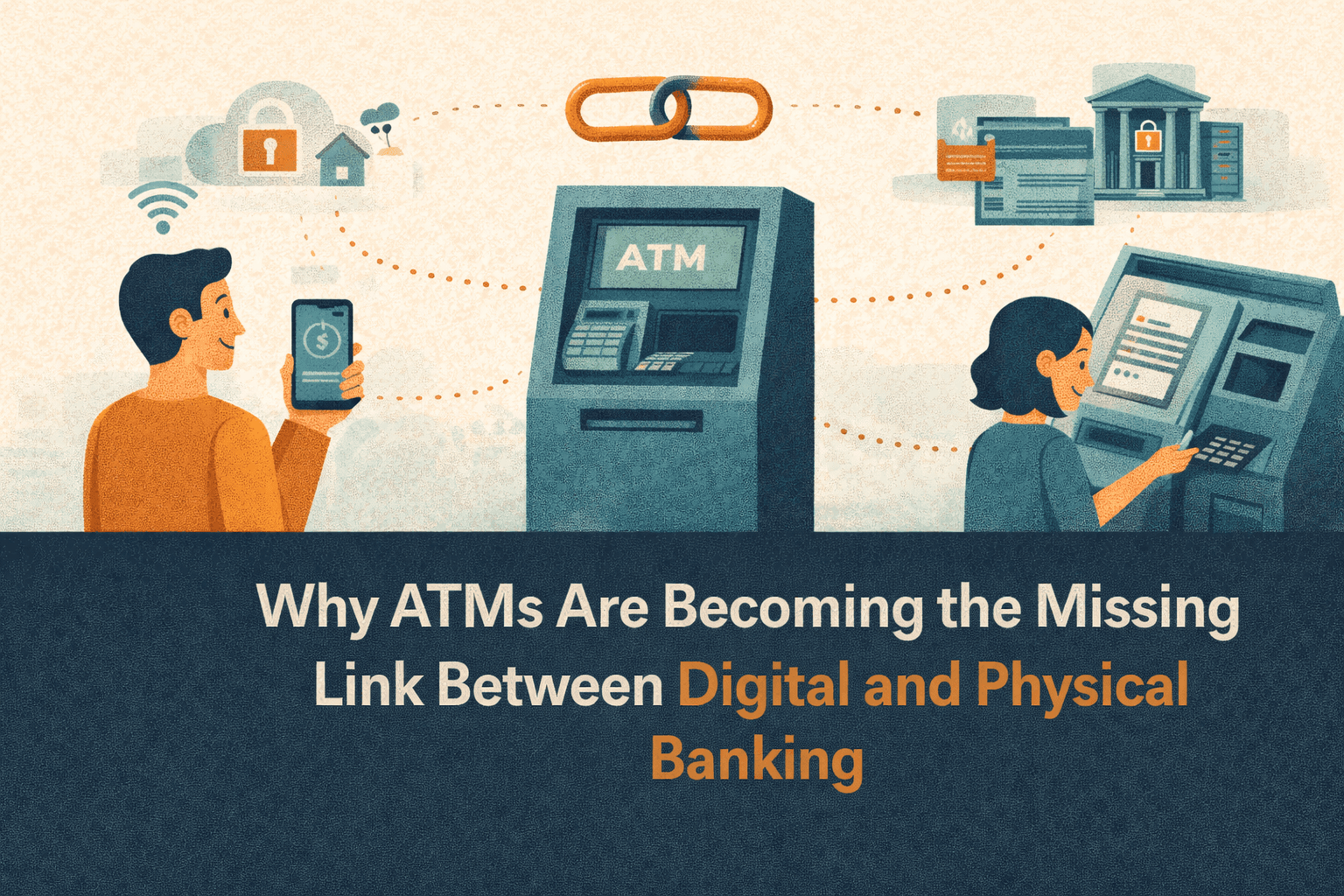
Mobile banking has become the dominant channel for everyday financial interactions. According to the ATM & Self-Service Software Trends 2025/26 report, 55% of consumers now prefer managing their accounts through mobile apps, far ahead of online banking and physical branches. At first glance, this shift appears to sideline the ATM. In reality, it is redefining its role.
Banks are increasingly repositioning ATMs as “phygital” gateways. Physical touchpoints that seamlessly connect digital journeys with real-world transactions.
The Paradox: Fewer Branch Visits, More ATM Reliance
While only 5% of consumers list ATMs as their primary banking channel, the report reveals that 51% of banks say they are more reliant on ATMs than a year ago. This apparent contradiction highlights a fundamental change: ATMs are no longer standalone channels competing with mobile apps. Instead, they are becoming extensions of digital banking.
As branches close and staff are redeployed, ATMs provide a cost-efficient way to maintain physical presence while supporting increasingly digital customer behavior.
Contactless and Mobile Integration Drive the Shift
To support this transition, banks are rapidly upgrading ATM capabilities. Over the past two years:
55% of banks rolled out contactless ATM transactions
49% enhanced ATM user interfaces
39% enabled cross-channel transactions
35% introduced QR code integration
These capabilities allow customers to initiate actions on their mobile devices and complete them at the ATM in seconds. Contactless ATM transactions now average around 15 seconds, delivering speed without sacrificing security. Because no card is inserted, the risk of skimming is reduced, and two-factor authentication is commonly applied.
User Experience Is Now a Strategic Priority
The report shows that banks increasingly view ATM software through a customer-experience lens. When selecting an ATM software supplier, enhanced user experience ranked among the top decision criteria, alongside security and system integration.
Modern ATM interfaces are being redesigned to mirror mobile and online banking experiences. In one example cited in the report, a bank significantly reduced transaction times after introducing responsive screens, guided animations, and personalized shortcuts such as pre-defined withdrawal amounts.
The objective is clear: ATM interactions should feel like a continuation of the digital journey, not a step backwards in time.
Speed First, Personalization
Unlike digital channels, ATMs operate in high-traffic environments where speed remains critical. The report emphasizes a layered approach: default to fast, simple transactions for most users, while applying personalization intelligently to make common actions even faster.
By recognizing returning customers and prioritizing their most frequent transactions, banks can increase both efficiency and satisfaction, without slowing down queues.
The Takeaway
ATMs are no longer defined by what they replace, but by what they connect. As banks embrace digital-first strategies, phygital ATMs are emerging as the bridge between mobile convenience and physical cash access.
Institutions that invest in seamless mobile-to-ATM experiences are not preserving legacy infrastructure. They are building a cohesive, future-ready banking ecosystem where physical and digital channels reinforce each other.
Sources
ATM & Self-Service Software Trends 2025/26, ATM Marketplace & KAL ATM Software, 2025.