Skimming Risks for ATMs, Banks, and Data Centers: Why the Threat Has Not Disappeared

Niklas Damhofer
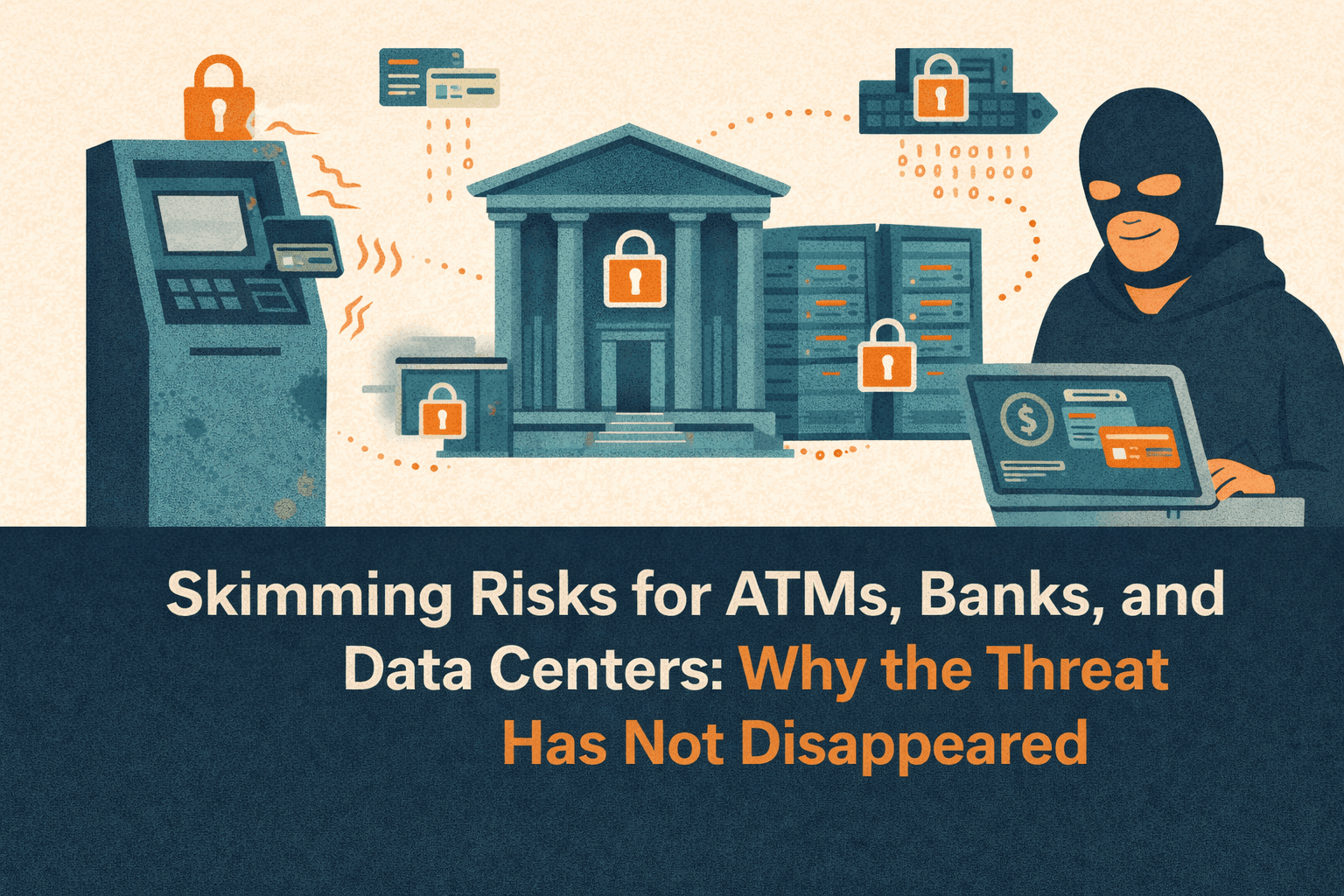
Skimming is often perceived as a legacy threat, something banks already solved years ago. In reality, skimming has evolved rather than disappeared. While classic card-overlay attacks are less common, modern skimming techniques target multiple layers of the ATM and banking ecosystem, including ATMs, branch infrastructure, and even data centers.
Understanding where skimming risks still exist is critical for effective prevention.
Skimming is no longer just a card reader problem
Early skimming attacks focused on physical overlays placed on card slots to capture magnetic stripe data and PINs. As EMV adoption reduced the value of cloned cards, attackers adapted.
Today’s skimming-related threats include:
Deep-insert skimmers hidden inside card readers
Shimmer devices embedded directly in reader slots
PIN capture via compromised PIN pads or cameras
Network-based interception of transaction or device data
Malware-assisted skimming through compromised ATM software
The shift is clear: skimming is now a hybrid threat combining physical access, software weaknesses, and operational gaps.
ATM-level risks: physical access meets software exposure
ATMs remain a primary target because they sit at the intersection of customer interaction and financial infrastructure. Risks increase when:
card reader or PIN pad integrity checks are insufficient,
device firmware is outdated or unverified,
alarms and tamper events are monitored but not acted upon,
software updates are delayed or inconsistently deployed.
A compromised ATM does not always show visible signs of attack. In many cases, devices continue operating normally while data is silently captured. This makes continuous monitoring and correlation of device events essential, not optional.
Bank infrastructure risks: skimming moves upstream
Skimming does not stop at the ATM. Banks face risk when:
internal networks are insufficiently segmented,
ATM management systems are exposed or poorly hardened,
authentication between components is weak or outdated.
Attackers increasingly aim to intercept data before or after it reaches the ATM, reducing the need for physical skimming devices altogether. This turns skimming into an infrastructure-level problem rather than a single-device issue.
Data centers: the overlooked skimming risk
Data centers are rarely associated with skimming, yet they play a crucial role in transaction processing, key management, and monitoring.
Risks arise when:
access controls are insufficiently enforced,
logging and audit trails are incomplete,
remote management systems are not tightly secured,
sensitive data flows are not fully encrypted end-to-end.
A breach at this level may not resemble traditional skimming, but the outcome is similar: unauthorized access to card or transaction data at scale.
Why skimming prevention is now an operational discipline
Preventing skimming is no longer about deploying a single countermeasure. It requires a coordinated approach across hardware, software, and operations:
Tamper-aware devices with reliable alerting
Up-to-date firmware and software with verified integrity
Centralized monitoring that correlates physical and logical events
Automated response workflows for suspicious patterns
Strict access control and auditability across all systems
Most importantly, skimming prevention must be treated as an ongoing process, not a one-time project.
Conclusion
Skimming has not disappeared, it has become more sophisticated and less visible. ATMs, bank infrastructure, and data centers are all part of the modern attack surface. Organizations that still view skimming as a purely physical ATM problem are already behind.
Effective protection requires continuous software lifecycle management, strong operational controls, and integrated monitoring across the entire self-service ecosystem. Only then can banks and operators stay ahead of a threat that continues to evolve quietly but persistently.
Sources
United States Secret Service — ATM & POS Terminal Skimming
This official government page explains how skimming devices are installed at ATMs and POS terminals to steal card data and PINs, and describes their impact on financial institutions and consumers.PCI Security Standards Council — ATM Security Guidelines (PDF)
The PCI SSC’s ATM Security Guidelines provide industry-accepted best practices specifically for mitigating magnetic-stripe and related skimming attacks, including both hardware and software countermeasures.ATMIA — ATM Industry Association Security Resources
ATMIA is a leading global trade association for ATM stakeholders; its security section and best practices efforts highlight how ATM crime (including skimming) remains a serious industry challenge.FTSI Corp — ATM Security: Strategies to Combat Skimming and Fraud
This industry-focused article explains why skimming remains a significant threat, outlines modern trends in skimming and fraud, and provides actionable insights into mitigation.SBSinnovate — ATM Skimming Risks: The Fast Facts
A concise guide that explains how skimming works today (including overlays, deep-insert devices, and “shimmers”), where it occurs most, and basic operational steps to reduce skimming risk.